Receivables
Management
The SAP modules for receivables management, SAP Dispute and Collections Management, offer professional dunning procedures for a smooth process from order to payment (“order-to-cash process”).
ORDER-TO-CASH PROZESS
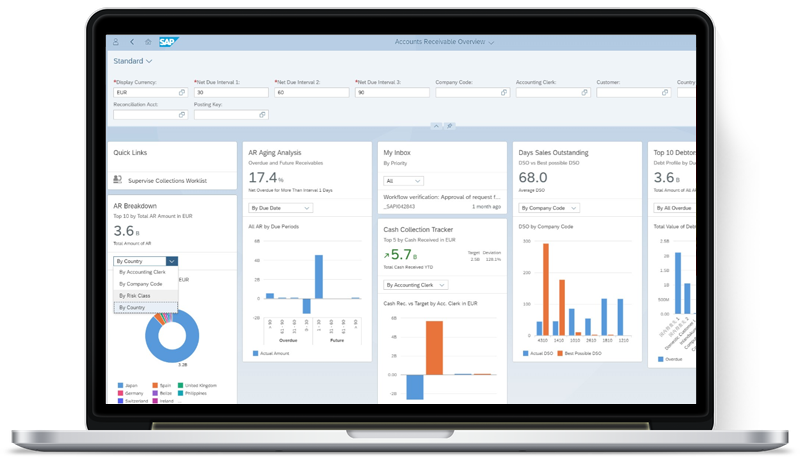
Many companies, especially those with corporate and communication structures, face challenges in the order-to-cash process. These challenges can include poor payment practices, payment defaults, and complaints.
These issues have an impact on the DSO (days sales outstanding) and cash flow, and thus on the company’s liquidity.
Particularly in complex corporate and communication structures, the SAP Dispute and Collections Management modules can significantly improve receivables management.
- Prevention of payment defaults
- Reduction of the usually high manual effort involved in clarifying cases and the long processing time
- Improvement of liquidity
SAP DISPUTE
MANAGEMENT
The SAP Dispute Management module includes functions for handling complex receivables-related clarification cases. It supplements the order–delivery–invoice–payment process chain in the stage between invoice and payment when disputes arise at this point.

You can use this function to create and process clarification cases, for example, when a customer disputes an invoice and therefore does not pay or only pays part of it.
Integration into your SAP landscape means that all relevant departments, such as sales, service, finance, logistics, shared services, etc., are involved, significantly reducing manual intervention and enabling interactive, real-time collaboration between departments.
Dispute Management enables you to control the process in such a way that an automated workflow is created when certain cases occur, for example, due to a certain dunning level or an insufficient payment.
- Multiple open customer items can be assigned to a single clarification case.
- Certain keys, such as planned closing date, processor, and processing data, can be filled in automatically.
- Analyses and evaluations via Fiori apps
- Transfer to collections management when a specific status is set
SAP Dispute Management advantages:
- Optimization of outstanding payment times and improvement of cash in and working capital management (WCM)
- Reduction in the amount and number of outstanding receivables and reduction in the associated risk
- Acceleration of the clarification process, effective work
- Increased satisfaction among your business partners
- Reduction in billing costs
- Transparent and meaningful reporting
- New resource and task planning thanks to newly gained time slots
Do you have any questions? We’re here to help!


SAP COLLECTIONS MANAGEMENT
Collections Management supports you in implementing proactive receivables management.
With the help of collection strategies, you can assess customers based on their previous payment behavior, creditworthiness, and other characteristics and react quickly in the event of late payments. Customers are assigned priorities according to specific rules and distributed across worklists.
- You can take early action to prevent defaults and ensure your liquidity.
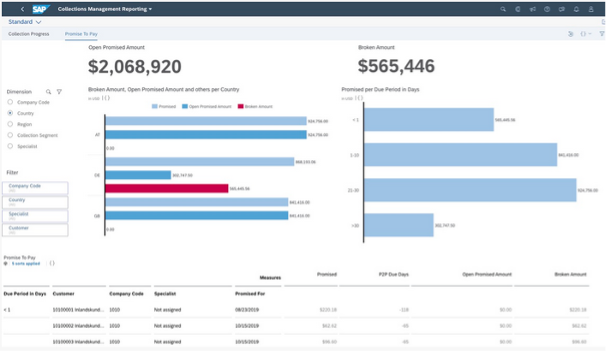
Collections Management features an interactive dashboard that enables automatic prioritization and distribution of various customer metrics. You can also get an overview of the current status of open invoices, recent payments, and customer contacts, as well as record and track status messages.
The priority lists serve as a basis for contacting customers in order of urgency, enabling you to collect outstanding receivables more quickly.
- You can grant permissions to control access to the documents underlying the claim and the records of collection-related contacts (permission concept).
- Payments and installment payments are automatically offered, calculated, and documented, regardless of scoring and creditworthiness.
- The relevant correspondence is automatically sent to the customer in a coordinated manner.
- All interactions and their results are automatically recorded in a log.
SAP CREDIT
MANAGEMENT
The creditworthiness and payment behavior of a company’s business partners have a direct impact on its business results.
Effective credit and receivables management reduces the likelihood of payment defaults, optimizes business relationships with business partners, and contributes positively to operating results.
SAP Credit Management in SAP S/4HANA helps companies structure and optimize credit management processes.
It is possible to identify default risks at an early stage, for example, based on customers’ past payment behavior. In addition, strategies for improving customer relationships can be derived and implemented to counteract potential payment default risks. These risks include, for example, issuing reminders, negotiating payment terms, or requiring advance payment from customers who are unable to meet their future payment obligations. This measure reduces both financial losses and the time-consuming intensive support of business partners.
SAP Credit Management allows you to manage credit centrally. Connected applications, such as Financial Accounting, are used to report the line item commitments of one of your business partners. The data is then consolidated in Credit Management and compared with the business partner’s current credit limit. The credit limit check can be used to determine additional data, such as the date of the last payment and the most recent open item.
The Business Partner solution is already integrated into the new SAP Credit Management. This tool makes it easier for you to process credit limit requests using workflows.
The SAP Fiori apps offer fast and effective evaluation of reports.
You get tools that let you perform mass updates of the business partner score and change credit limits. You can also use these tools to perform recurring credit checks and have credit decisions documented automatically.
- Minimizing payment defaults
- Focus on reliable and credible business partners
- Fast and uncomplicated processes
- Effective and automated credit decisions
- Establishment of centralized credit management in a multi-system environment
- Automated calculation or derivation of internal creditworthiness, risk class, and credit limit
- External ratings are stored by connecting them to external credit agencies such as Creditreform.
- There is no need to use third-party products, as all processes run in SAP.
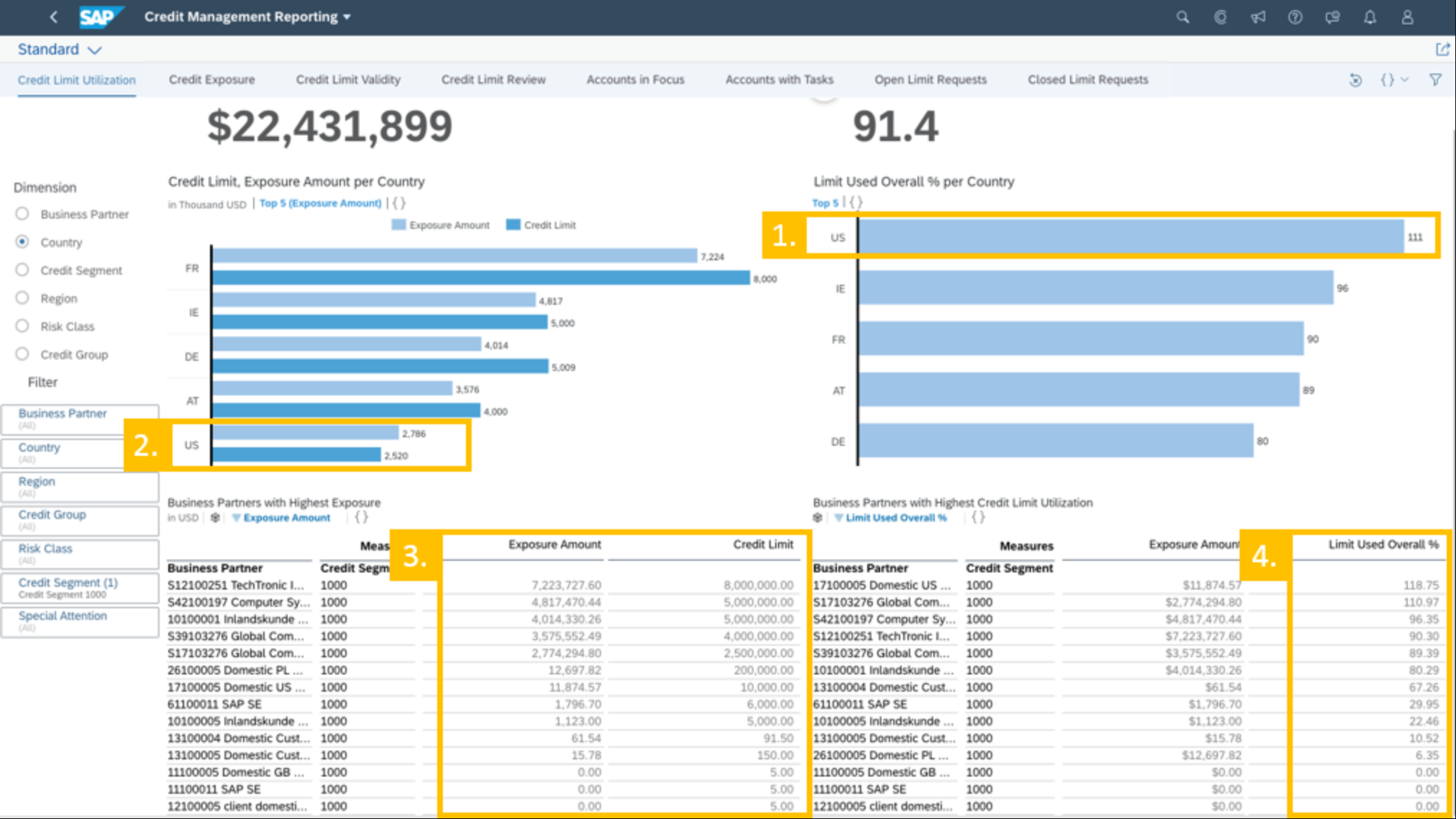
2. Credit limit and commitment by country
However, the total commitment for U.S. debtors is lower than for other countries.
1. Total credit limit utilization in % by country
Debtors in the United States have the highest total credit limit utilization. In fact, it is 100%.
3. Business partners with the highest exposure
You can use these tables to assess the absolute exposure or credit limit amounts.
4. Business partners with the highest credit limit utilization
This table shows debtors who are close to or above their credit limits.
FUNCTIONS:
Credit master data for business partners
All credit-related data for a business partner is managed in SAP Credit Management. This data includes the current credit limit, external credit ratings, and risk class. Each of the master data fields has a history that reflects the time of the change, the user, and the old and new values. There is also a note function that you can use to store additional information about the business partner. In SAP Credit Management, you can include the collateral stored for a business partner in the calculation of the commitment. This ensures seamless monitoring of your own risk.
Business partner evaluation and credit information
SAP Credit Management lets you determine and manage both external and internal credit information for a business partner. This information forms the basis for the Credit Rules Engine. This method is used to automatically perform business partner evaluations, make credit decisions, or set credit limits. The internal and external credit information is stored and monitored in the business partner's master data. Creditworthiness data can be updated manually or automatically.
Credit rating and credit limit determination, as well as credit limit check (Credit Rule Engine)
SAP Credit Management enables you to automate workflows using rules. The Credit Rules Engine supports the following automated business processes:
Credit rating of business partners
Each business partner is assigned a formula for calculating their credit rating. You can define the formula freely, with a wide range of data available as initial parameters. With SAP Credit Management, you can recalculate the credit rating and change the assessment procedure.
Determining the credit limit amount
You can automatically set a credit limit for a business partner and use SAP Workflow to set up an approval procedure for adjusting a credit limit.
Rules for credit checks
You can define rules that specify which checks are to be performed during a credit check for an order. In addition to checking credit limit utilization, you can perform other checks, such as the maximum age of the oldest open item or the maximum number of dunning procedures for the business partner. You can define what effect a negative result of a check should have on SAP Credit Management (for example, block customer account, activate workflow).
Credit information and credit decisions
Information from various systems is required to make quick and efficient decisions about blocked orders or the amount of the credit limit set, which forms the basis for economic credit decisions.
Satisfied customers
Many organizations and companies in the DACH region rely on Unittwo Consulting to develop customized and sustainable solutions for their SAP systems.








Inquiries and contact
Do you need support with an SAP project? We are here for you – feel free to contact us by email or phone or use the contact form to get in touch.
Unittwo Consulting
Körnergasse 7/1, 1020 Vienna
Business hours
Mon–Fri: 9 a.m.–6 p.m.